Advanced Orthodontics, Implants & Cosmetic Dentistry in Gangnam, Seoul · International Patient Concierge

Dental Guide
Computer-Guided Implant Surgery vs Conventional: Guide
Computer-guided implant surgery vs conventional placement: how 3D navigation improves precision, and what it means for implant patients in Seoul, Korea.
Schedule a ConsultationNavigation (Computer-Guided) Implants vs Conventional Placement: What's the Difference
Medically reviewed by Dr. Soyoun Lee, Oral & Maxillofacial Surgery Specialist, Smile View Dental Clinic · Last updated July 2026
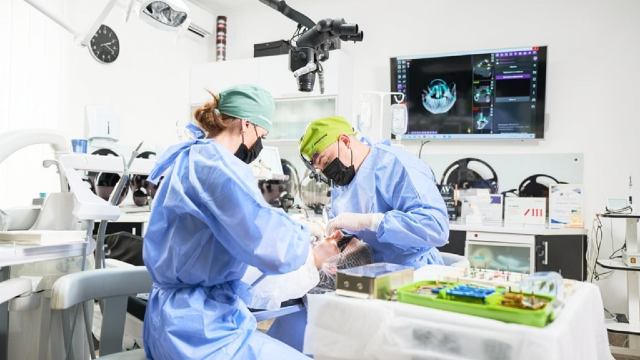
When you compare computer guided implant surgery vs conventional placement, the difference comes down to how the implant position is planned and controlled. Conventional (freehand) placement relies on the surgeon's direct vision, experience, and hand control. Computer-guided placement — the approach Smile View Dental Clinic in Gangnam, Seoul calls its Navigation technique — uses 3D imaging and computer guidance to plan the implant in advance and place it with added precision. Both approaches can produce excellent results in the right hands; this guide explains how they differ so you can understand what your treatment plan involves.
A dental implant is a titanium artificial tooth root placed in the jaw to support a replacement tooth. Because that root sits close to nerves, sinuses, and neighboring tooth roots, where and at what angle it is placed matters a great deal. That is precisely what guided and conventional methods handle differently.
What is the difference between guided and conventional implant placement?
The main difference is planning and control: conventional placement is done freehand based on the surgeon's direct assessment during surgery, while computer-guided (Navigation) placement follows a 3D digital plan created before the procedure. In other words, guided surgery front-loads the precision work into the planning stage.
At Smile View Dental Clinic, dental implants are offered through three documented surgical approaches:
- Immediate Implants — placed right after extraction to reduce treatment time and minimize bone loss.
- Navigation (computer-guided) Implants — 3D imaging and computer guidance are used to minimize errors and speed recovery.
- Bone Graft Implants — bone volume and density are added when the jaw has insufficient bone.
Navigation is not a separate implant product; it is a method of placing the implant. It can be paired with the clinic's brands and matched to your case. The alternative — conventional freehand placement — remains a well-established technique used successfully in dentistry around the world.
How does conventional (freehand) implant placement work?
Conventional placement means the surgeon positions the implant during surgery using direct vision, tactile feedback, and clinical experience, informed by pre-operative X-rays or scans. There is no physical guide or live on-screen navigation directing the drill in real time.
The general sequence looks like this:
How does Navigation (computer-guided) implant placement work?
The general workflow for guided surgery is:
More Dental Articles
Continue reading our clinical dental guides.

Korean Dental Anesthesia Market: Projected $80M Revenue by 2035
In the rapidly evolving landscape of South Korean healthcare, patient comfort has transitioned from a luxury to a baseline expectation.
Learn More

Why Non-Surgical Orthodontics Reduces Long-Term Dental Costs
The landscape of dental care in South Korea is shifting rapidly as patients increasingly prioritize long-term functional health over quick aesthetic fixes.
Learn More

Comparing Orthodontic Treatment Fees: Korea vs Japan Benchmarks
The decision to pursue orthodontic treatment is a long-term investment in both oral health and facial aesthetics. For patients in the Asia-Pacific region, South Korea and Japan represent the two most prominent hubs for advanced dental care.
Learn More